Pros & Cons of Leveraged ETFs When Selling Stock Options – October 20, 2025
Retail investors may become enticed to use leveraged exchange-traded funds (ETFs) when writing covered calls or selling cash-secured puts. The reason is that the option returns are generally so much greater than traditional ETFs. This article will use ProShares UltraPro QQQ (Nasdaq: TQQQ) and Invesco QQQ Trust (Nasdaq: QQQ) to investigate the advantages and disadvantages of employing leveraged ETFs.
What are ETFs?
Securities that track an index, commodity or a basket of assets like an index, but trade like a stock on an exchange. They provide the diversification of an index fund. One example is QQQ which offers exposure to and mirror the performance of the 100 largest non-financial stocks that are listed on the Nasdaq exchange.
What are leveraged ETFs?
This is a fund that seeks to magnify the returns of an underlying index or fund, typically 2x or 3x the daily performance. This is achieved via the use of financial derivatives like futures contracts and options. One example is TQQQ which seek 3x the exposure to the Nasdaq 100 stocks. This means that the price movement to the upside or downside is expected to be triple that of QQQ. We will confirm that through the use of a comparison chart and implied volatility (IV) stats from option chain.
Comparison chart of QQQ & TQQQ with the S&P 500

- TQQQ has much greater upswings and price declines than QQQ
- QQQ will out- and under-perform the S&P 500, but not the extent like TQQQ
TQQQ & QQQ option chains
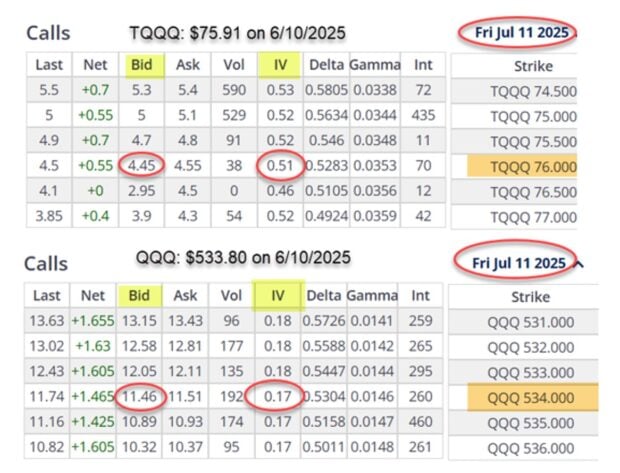
- TQQQ: The $76.00 near-the-money call strike has a bid price of $4.45 and an implied volatility of 51% (top chart)
- QQQ: The $534.0 near-the-money call strike has a bid price of $11.46 and an implied volatility of 17% (lower chart)
- Note the implied volatility o TQQQ is triple that of QQQ. This is to be expected based on the stated goal of TQQQ
- Will the initial returns also be triple? Let’s find out
TQQQ and QQQ initial calculations with our BCI Trade Management Calculator

- After entering the data gleaned from the option chains, we calculate the initial 32-day returns for QQQ to be 2.09%, 23.86% annualized (brown cells)
- After entering the data gleaned from the option chains, we calculate the initial 32-day returns for TQQQ to be 5.86%, 66.87% annualized (pink cells)
- These initial returns align with our expectations of an approximate 3-to-1 ratio, because the returns will be directly related to the IV of the underlying securities for the same timeframe
Discussion (my take)
Utilizing leveraged ETFs may be appropriate for investors who are seeking greater returns and willing to incur higher risk. However, covered call writing and selling cash-secured puts are low-risk option selling strategies typically appropriate for investors with capital preservation in mind. In my humble opinion, most retail investors should avoid leveraged ETFs, especially when implementing low-risk option strategies, with the caveat that its use may be applicable for higher risk investors.
Author: Alan Ellman