Beware of the Shiny Object When Establishing Covered Call Trades
One of the more common oversights made by retail investors is their focus on premium dollar amounts rather than annualized returns. I consider this “dollar distraction” the shiny object that prevents us from focusing on the more pertinent annualized returns. In this article, I will be analyzing real-life examples with NVIDIA Corp. (Nasdaq: NVDA) to demonstrate how to avoid these shiny objects.
NVDA data on Jun 4, 2025
- NVDA trading at $141.39 on 6/4/2025
- The 6/6/2025 $144.00 call has a bid price of $0.72
- The 7/3/2025 $144.00 call has a bid price of $4.70
- The 6/18/2026 $144.00 call has a bid price of $27.20
- Can you see how enticing that 6/18/2026 premium can be for retail investors? Me too
NVDA 3-Option-Chains on 6/4/2025

NVDA Initial Calculations of the 3 Expiration Dates
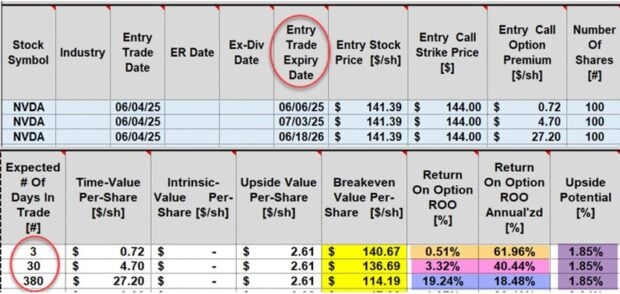
- Calculations using the BCI Trade Management Calculator (TMC)
- The shortest-term 6/6/2025 expiration shows an initial 3-day return of 0.51%, 61.96% annualized
- The 30-day initial return is 3.32%, 40.44% annualized
- The longest-term, 380-day LEAPS initial return is 19.24%, 18.48% annualized
- We must avoid the “shiny object” dollar amount return from long-dated options and focus on the annualized returns
Discussion
When crafting our covered call trades, we must concentrate on the annualized returns, not the actual premium dollar amount. Even the initial % return must be viewed in the context of the time frame of the trade. For example, a 2% initial return r a 1-month contract obligation is appropriate for many of us. However, a 2% 6-month return just doesn’t cut it for a majority of retail investors. Watch out for the shiny object!
Author: Alan Ellman