Calculating Realized & Unrealized Returns for an Expiring Worthless Covered Call Trade – December 1, 2025
We enter a covered call trade and share price declines, but not enough to trigger our 20%/10% BTC/ GTC limit orders (exit strategy buyback price points). The option expires worthless.
There may be confusion on 2 fronts: How do we calculate our returns, given we still own the depreciated shares and what share price entry do we use if we sell another covered call on the stock in the next contract cycle.
In this article, a real-life example with Skyward Specialty Insurance Group Inc. (Nasdaq: SKWD), will be analyzed to offer a reasonable solution (I hope you agree with the adjective) to both questions.
Initial trades with SKWD
- 5/12/2025: Buy 100 x SKWD at $59.75
- 5/12/2025: STO 1 x 6/20/2025 $60.00 call at $3.31
- 6/20/2025: SKWD closes at $57.33 as the contracts expire worthless
- What are the final realized/unrealized returns?
- How do we enter the stock price if we sell another covered call for the next contract cycle?
Final realized/unrealized returns on 6/20/2025, using the BCI Trade Management Calculator (TMC)
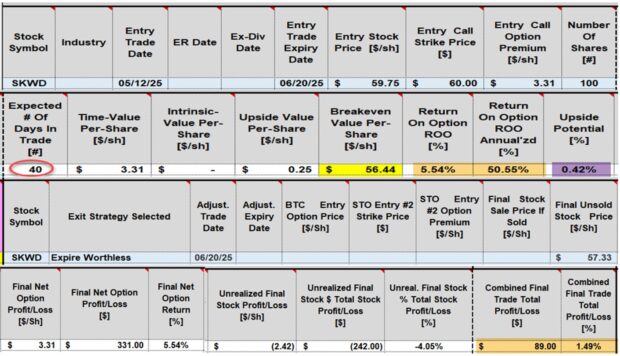
- The top row shows initial trade entries
- The 2nd row from the top shows initial trade calculations
- The 3rd row from the top shows the exit strategy allowed (“expire worthless”) and expiring share price
- The bottom row calculates the final unrealized share loss of 4.05% and realized option gain of 5.54%
- The net realized/unrealized gain is $89.00/contract or 1.49% 40-day return (brown cells on the bottom)
Discussion at contract expiration
- The shares can then be sold at a, now, realized net profit or we can write another covered call for the next contract cycle
- The next strike can be ITM or OTM depending on whether we decide to take a defensive or more aggressive posture
- If we decide to retain the shares, our price entry into the next TMC spreadsheet will be $57.33, because the share loss to-date is already in the previous contract calculation
Author: Alan Ellman