Covered Call Writing ETFs: Do They Deserve to Be So Popular? – January 26, 2026
Covered call writing ETFs are exchange-traded funds consisting of a portfolio of stocks that are leveraged to generate income by selling call options against those shares. As investors strive to generate high yield returns, these securities have exploded in popularity. This article will explore 3 of the more popular covered call ETFs and determine if this popularity is justified.
3 popular covered call writing ETFs
- JPMorgan Equity Premium Income ETF (NYSE: JEPI): Uses low-implied volatility well-diversified S&P 500 stocks.
- Global X Nasdaq 100 Covered Call ETF (Nasdaq: QYLD): Writes covered calls on the Nasdaq 100 stocks.
- Global X S&P 500 Covered Call ETF: (NYSE: XYLD) Passively managed fund that writes at-the-money covered call on the entire S&P 500 index.
Let’s talk expense ratios
One of the most important factors in determining the returns, and, therefore, success of an ETF is its expense ratio. These are administrative, marketing and management fees inherent in the security. These fees are deducted from the overall performance of the ETF. Here’s a comparison of the expense ratios of the 3 covered call ETFs and that of Vanguard 500 Index Fund Admiral Shares (VFIAX), a broad market, low expense ratio mutual fund based on the S&P 500.
- VFIAX: 0.04%
- JEPI: 0.35% (9x that of VFIAX)
- QYLD: 0.60% (15 x that of VFIAX)
- XYLD: 0.60% (15 x that of VFIAX)
These expense ratios are difficult to overcome, especially when stock selection, option selection and position management techniques are not implemented.
1-year comparison chart: A picture is worth a million words
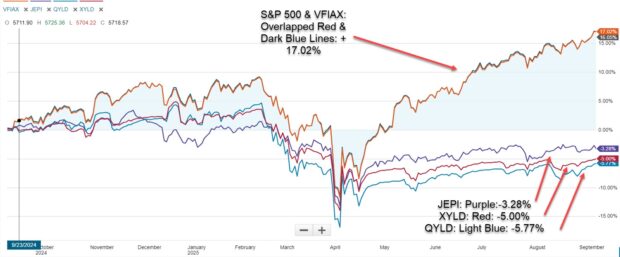
The difference between the S&P benchmark and a corresponding mutual fund versus the 3 popular covered call writing ETFs is dramatic.
Discussion
For those seeking to beat the market on a consistent basis and many years significantly, covered call writing will offer that potential once the strategy is mastered. On the other hand, covered call writing ETFs do not provide such opportunities because the expense ratios are much too high and stock selectivity, option selectivity and exit strategy implementation are not maximized.
Author: Alan Ellman