What is the “Square Root of Time Rule” & How Does it Impact Option Expiration Date Selection? – March 9, 2026
You’re selling 4, 1-month covered call contracts for the $100.00 strike and generating $1000.00 in premium. Pretty good, right? But wait a minute … if I sell 4, 6-month $100.00 strikes, I can make $2,500.00. Seems like a no-brainer to get $2500.00 up front. Before you say yes or no, let’s review the Square Root of Time Rule and then analyze a real-life example with AAPL.
What is the Square Root of Time Rule?
This states that an options price (and volatility) is roughly proportional to the square root of it time-to-expiration. For example, an at-the-money option with 4x the amount of time-to-expiration compared to another, will generate only double the price (not 4x) … the square root of 4 = 2. This implies that in order to compare “apples-to-apples”, we must annualize our returns, so all choices are playing on the same field.
Real-life example with Apple Inc. (Nasdaq: AAPL)
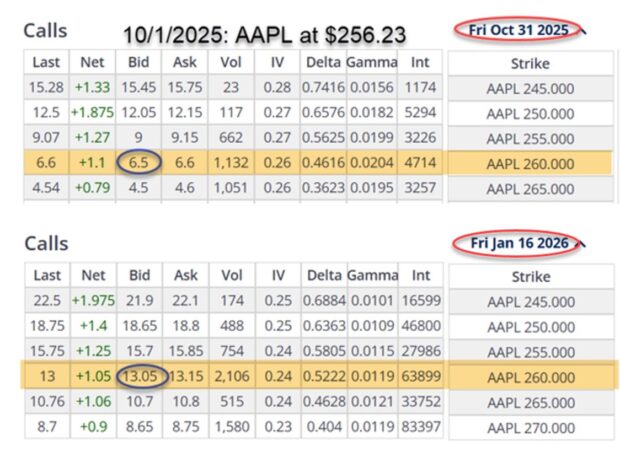
- 10/1/2025: AAPL trading at $256.23
- 10/1/2025: The (1-month) 10/31/2025 $260.00 call has a bid price of $6.50
- 10/1/2025: The (3 1/2-month) 1/16/2026 $260.00 call has a bid price of $13.05
- Using the Square Root of Time Rule, (Square root of 3.5) we would expect a premium of 1.87 x that of the monthly ($6.50) or $12.16. $13.05 is pretty close
AAPL option-chains
Using the BCI Trade Management Calculator (TMC) to compare annualized returns
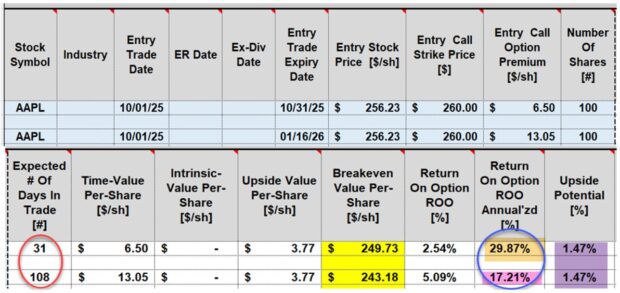
- Red circle: calculates the days-to-expiration (DTE) of 31 and 108 days
- Purple field: The same amount of upside potential (1.47%)
- Blue circle: The shorter-dated option has an annualized return of 29.87% (brown cell); while the longer-dated option shows an annualized return of 17.21% (pink cell)
Discussion
The Square Root of Time Rule is instructive in that it demonstrates that shorter-dated options generally return greater annualized returns compared to longer-dated options. So, put on your sunglasses and avoid the shiny objects of higher premium dollar amounts. It’s all about annualization.
Author: Alan Ellman