The Option Greeks Meet Portfolio Overwriting
Portfolio overwriting is a form of covered call writing where share retention is an additional requirement for the strategy goals. The option Greeks are financial metrics that measure the risk and pricing sensitivity of our option contracts. This article will analyze how the Greeks can assist us by enhancing our portfolio overwriting results. A real-life example with NVDIA Corp. (Nasdaq: NVDA) will be used.
What are the 5 option Greeks?
- Delta
- Gamma- 2nd generation Delta, the “Delta” of “Deltas”
- Theta
- Vega
- Rho- not a major Greek
Delta Defined & Applications
- Delta is the amount an option price will change for every $1.00 change in share price
- –How to use the 20%/10% exit strategy guidelines
- –Which strikes to use as stock surrogates (The Poor Man’s Covered Call, for example)
- Delta is the equivalent number of shares represented by the options position
- –More for high-wealth portfolio managers
- –Delta-neutral portfolios
- Delta is the percentage likelihood that, upon expiration, the option will expire in-the-money or with intrinsic value (subject to exercise)
- Portfolio overwriting- avoid exercise of low-cost-basis shares
- Deep OTM puts- avoid having shares “put” to us
- Deep ITM calls- avoid stock price dropping below breakeven price point
Theta Defined & Applications
- Estimate of how much the theoretical value of an option will decline with the passage of 1 calendar day
- Assists us in determining when to enter our trades
- Assist us in the most appropriate exit strategies to use
- 20%/10% BTC-GTC limit orders
- “Hitting a Double” versus “rolling-down”
Vega Defined & Applications
- Amount an option price changes with a 1% change in implied volatility of the underlying security
- Extremely important to integrate implied volatility into our option trading decisions
- IV can also be used to determine an expected trading range for a specific contract
- Greater implied volatility = larger premiums = greater risk to the downside
- IV is inherent in our option time-value components
- Our initial time-value return goal range can be used to measure the risk of our trades
- 2% – 4%/month, for me
- 1/4th that amount for weekly expirations
- Much lower for portfolio overwriting
How to use Delta for portfolio overwriting: Use low deltas to decrease the risk of exercise (expiring ITM): NVDA option chain
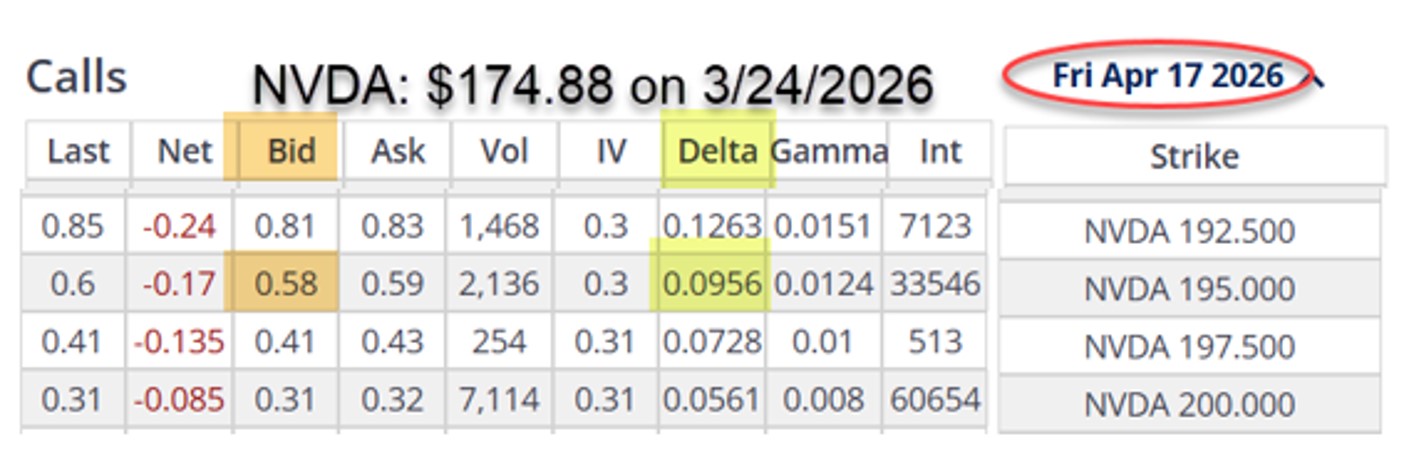
With NVDA trading at $174.88, the $195.00 OTM call strike has a delta (risk of expiring ITM and subject to exercise) of 9.5% (yellow cell) and a bid price of $0.58 (brown cell).
Delta calculations for NVDA (9.5% risk of exercise w/o exit strategies)
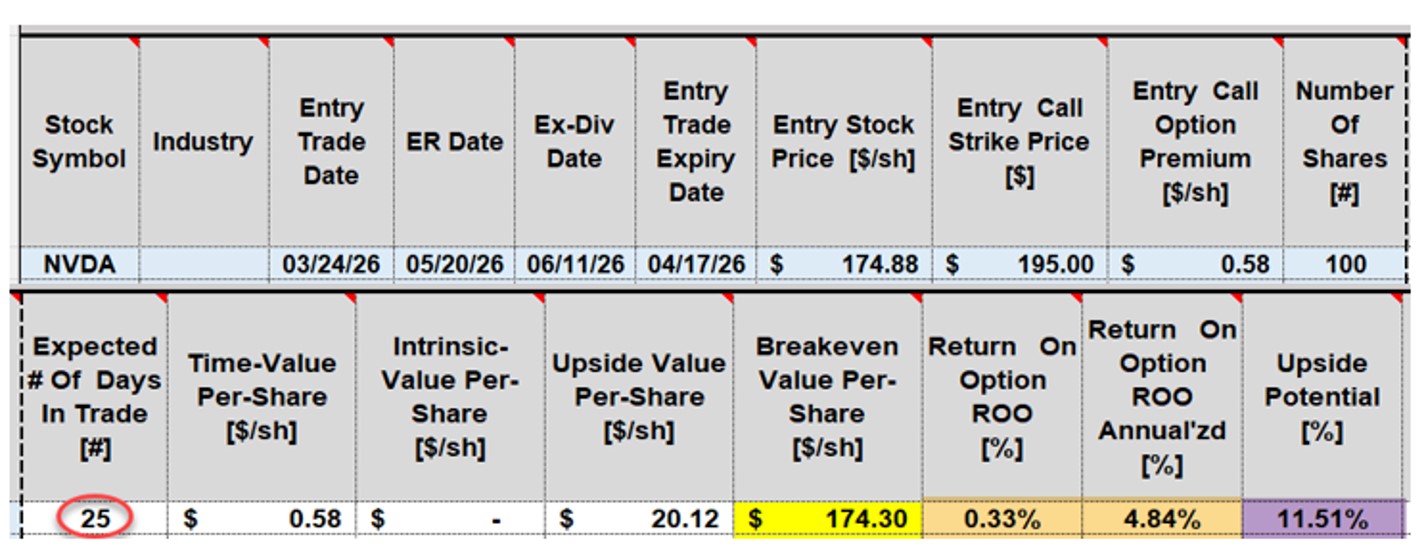
- This 25-day trade, shows an annualized return of 4.84% (brown cell) with an opportunity of an additional 11.51% of share appreciation potential (purple cell)
- Calculations accomplished with the BCI Trade Management Calculator (TMC)
How to use Theta for portfolio overwriting: Graphic representation of time-value decay
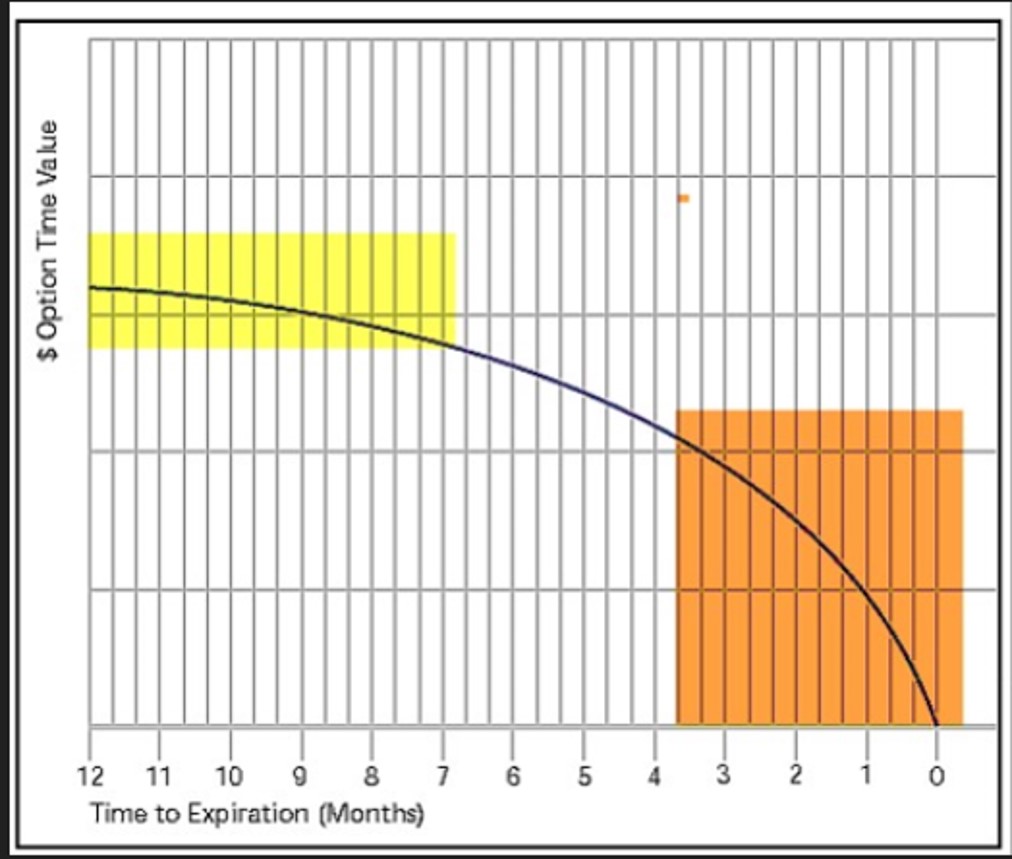
- The theta (time-value) decay starts slowly (yellow field)
- As expiration approaches, the rate of time-value decay accelerates dramatically (brown field)
- Since we are selling short-term options (weekly and monthly), theta guides us to entering the trades early in the contract cycle
How to use Vega for portfolio overwriting: Can guide us to appropriate strike selection
- Implied volatility (IV) is based on an annualized basis and 1 standard deviation (SD- falls in the calculated range 68% of the time; 16% on the high end and 16% on the low end)
- The high end of the range represents a 16% risk of expiring ITM and subject to exercise
- The BCI Expected Price Movement Calculator has a conversion formula to convert the IV from the annualized stat to one reflecting the specific contract in question
- The price movement is calculated using the at-the-money (ATM) IV
- If we wanted to take less risk of exercise, we could use 2 SDs by doubling the calculated price movement and incur a 2.5% risk of expiring ITM and subject to exercise
- ***We could always buy back the option prior to expiration and prevent exercise if there is substantial share price acceleration
The BCI Expected Price Movement Calculator: NVDA has an ATM IV of 36%
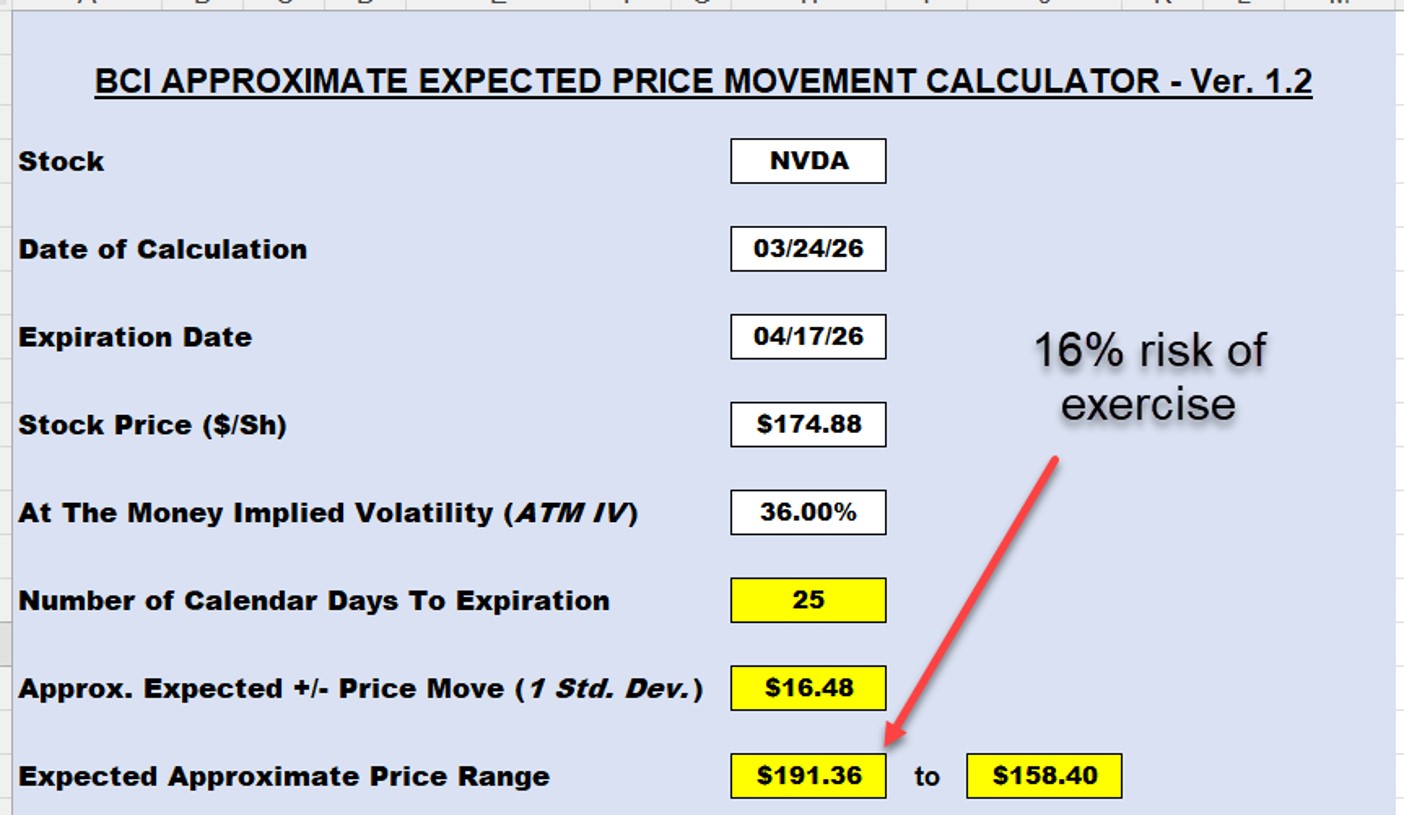
- For a 16% risk factor, we would select a strike near $191.00
- For a 2.5% risk factor (2 SDs), we would double $16.48 and select a strike near $208.00
- Always check the annualized return to make sure it aligns with our pre-stated initial time-value return goal range