Ultra-Defensive Covered Call Writing – August 10, 2026
In March of 2026, during the US – Iran War, I was favoring deep in-the-money (ITM) covered call strikes and deep out-of-the-money (OTM) cash-secured put strikes. This allowed me to continue to generate significant initial time-value returns, while retaining considerable protection to the downside. In this article a covered call writing example will be analyzed using EQT Corp. (NYSE: EQT).
Why choose EQT?
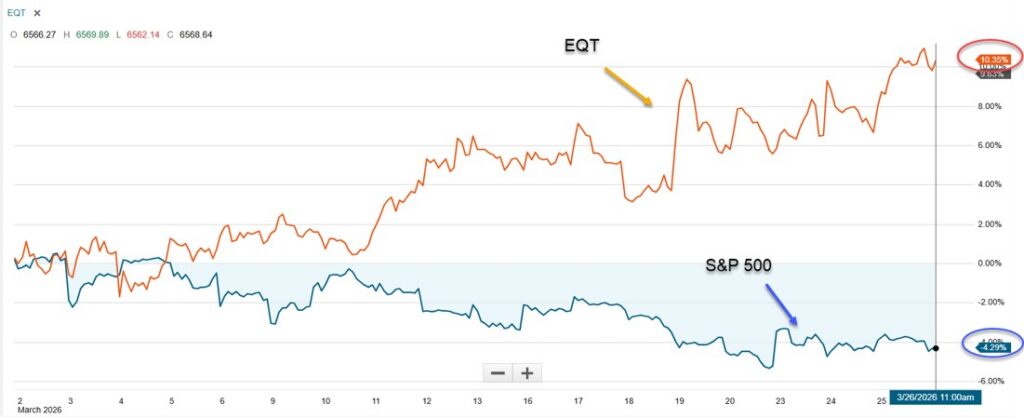
Based on our Weekly Stock Screen & Watch List :
- Located in the energy sector, ranked “A” at that time
- Mean analyst rating (MAR) of 1.69 (1-5, with 1 being the best)
- On balance volume (OBV) bullish
- Adequate stock & option liquidity
- No interference from earnings or ex-dividend dates
1-month comparison chart with the S&P 500 on 3/26/2026
Strike Price analysis for ultra-defensive covered call trades
- At-the-money (ATM) and out-of-the-money (OTM) strikes have only time-value components
- In-the-money (ITM) strikes have both time-value (extrinsic-value) and intrinsic-value components (amount the strike is lower than current market value)
- ITM strikes offer greater protection to the downside due to the lower breakeven price point (stock price – total premium)
- In volatile and uncertain wartime conditions, ITM strikes should be given serious consideration
- ITM strikes have higher deltas than ATM and OTM strikes
Delta analysis for ultra-defensive covered call trades
- One of the (3) definitions of delta is the approximate probability of the option strike expiring ITM and subject to exercise
- Using ITM strikes affords greater protection to the downside, but makes exercise more likely, so share retention cannot be a requirement
- In this scenario, the lower the strike, the greater the protection to the downside, the lower the time-value premium return and the higher the delta
- We seek higher delta strikes that will still generate significant time-value annualized returns. We do not want the stock price to move lower than the deep ITM strike and then become OTM (For example, a $48.00 stock dropping below a deep ITM $40.00 strike)
Delta analysis for EQT on 3/26/2026
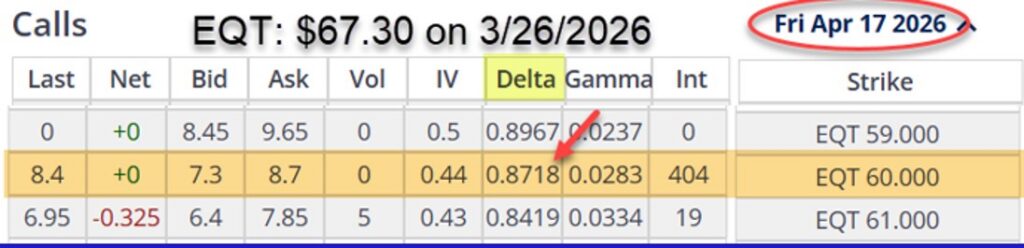
- There is an approximate 87% probability of a successful trade (13% risk of share price moving OTM (lower than the $60.00 strike)
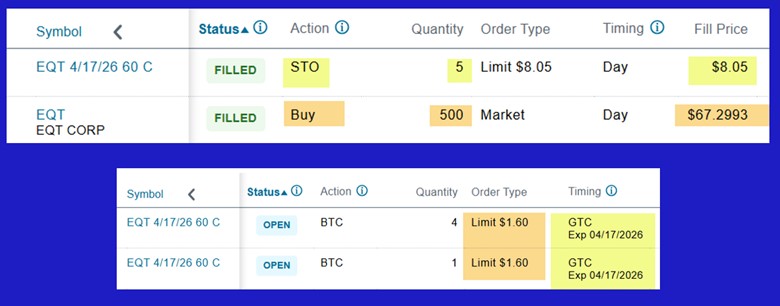
- I was able to “negotiate” a bid price of $8.05 for 5 contracts, after purchasing 500 shares at $67.30
Initial calculations using the BCI Trade Management Calculator (TMC)
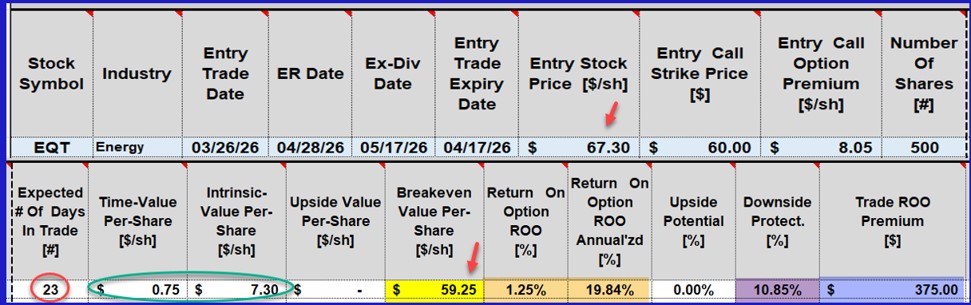
- Red circle: 23-day trade
- Green oval: time-value and intrinsic-value
- Yellow cell: Breakeven price
- Brown cells: Initial 23-day and annualized returns
- Purple cell: How much share price can decline and still realize the 19.84% annualized return
- Blue cell: $375.00 of time-value premium generated into our cash account ($0.75 x 500)
- The 20% BTC/GTC limit order was placed at $1.60 (20% of $8.05) to protect against significant share price decline
Broker confirmation of trades
Discussion
- This was a defensive 5-contract ultra-defensive covered call trade
- Modest-robust IV stocks & ETFs can generate substantial initial and final returns
- ITM, high-delta covered calls should be given serious consideration in challenging markets
- Trades must be monitored whether high- or low-risk (20%/10% guidelines)
- When writing ultra-defensive cash-secured puts, high delta strikes should be considered. Delta will approximate the probability of the strike expiring ITM, which is what we want
- When using this strategy approach, share retention is not a requirement
Author: Alan Ellman